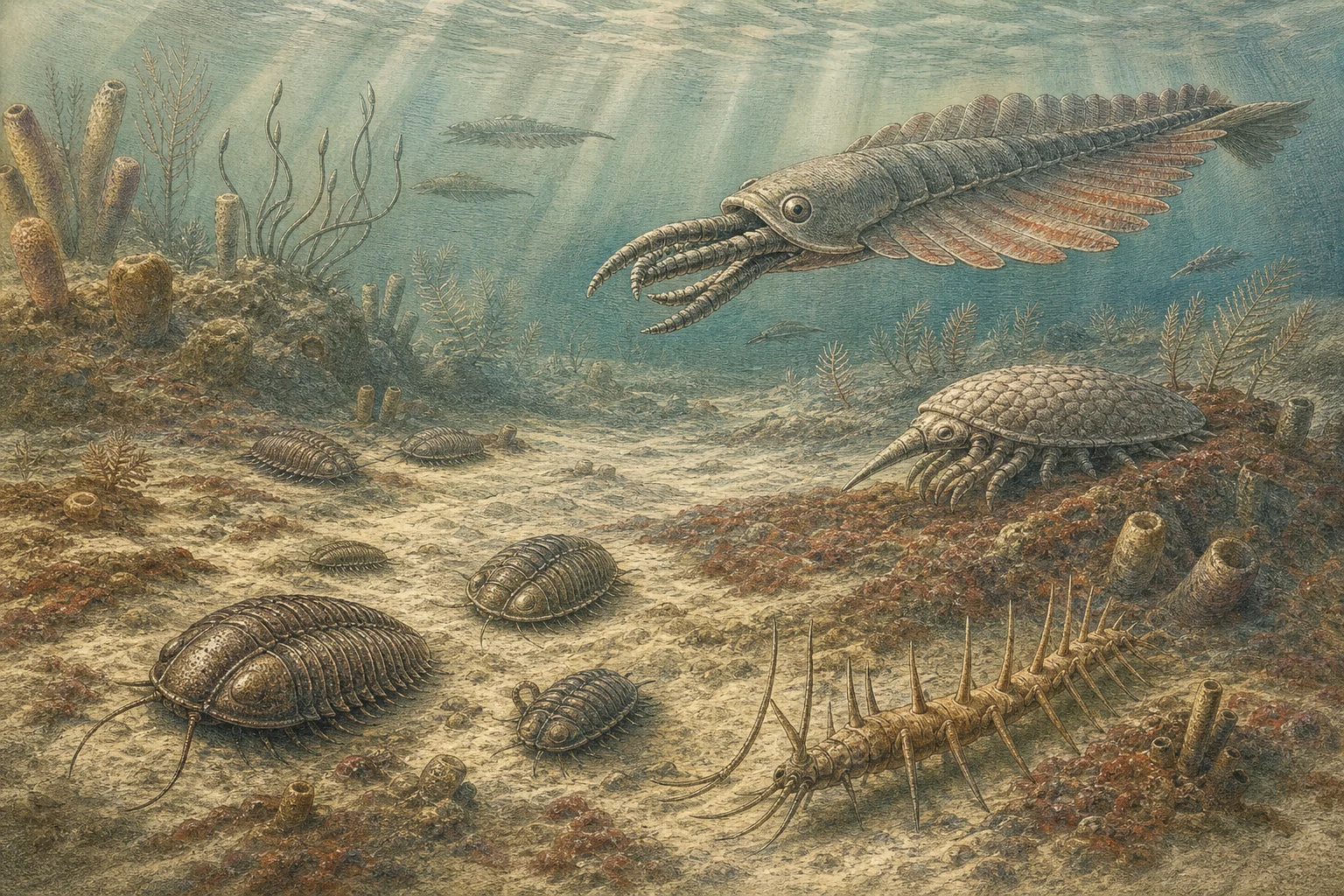
Between about 541 and 520 million years ago, the fossil record begins to display abundant animals with shells, skeletons, jointed limbs, eyes, guts, and varied modes of life. This Cambrian radiation is sometimes described as an explosion, but the metaphor can mislead. It occupied tens of millions of years and had roots among small, soft-bodied Ediacaran organisms.
Bodies become ecological instruments
Cambrian seas contained trilobites, sponges, worms, brachiopods, molluscs, early chordates, and stem relatives of modern groups. Organisms burrowed deeper into sediment, filtered water, grazed microbial mats, hunted, scavenged, and defended themselves. Predation likely encouraged armor, mobility, sensory systems, and new behaviors; those innovations changed the environment for other species in return.
Exceptional deposits such as Chengjiang and the Burgess Shale preserve soft tissues that ordinary fossilization loses. Their unfamiliar forms are not failed drafts. Some represent extinct branches; others preserve combinations of traits near the stems of living groups.
Why then?
No single trigger is sufficient. Rising oxygen may have supported active bodies. Changes in ocean chemistry favored mineralized skeletons. Developmental gene networks made new anatomical variation possible. Ecological escalation amplified successful innovations. Continental and climatic changes altered habitats. These hypotheses complement rather than exclude one another.
Molecular clocks indicate that several animal lineages diverged before their conspicuous Cambrian fossils. A lineage can exist before it becomes abundant, mineralized, large, or preserved in a sampled environment.
The Cambrian record is an interaction between biological diversification and a changing archive of preservation.
Not every modern phylum appeared complete
Cambrian organisms should not be forced into modern categories. Early members of a lineage often lack specialized features acquired later. Paleontologists distinguish stem groups, which lie outside the living crown but share part of its ancestry, from crown groups, which include the last common ancestor of living members and all its descendants.
The radiation reveals evolution constructing ecological systems through branching experimentation. Its enduring result was not a fixed catalogue of body plans, but oceans in which animals increasingly shaped one another’s possibilities.