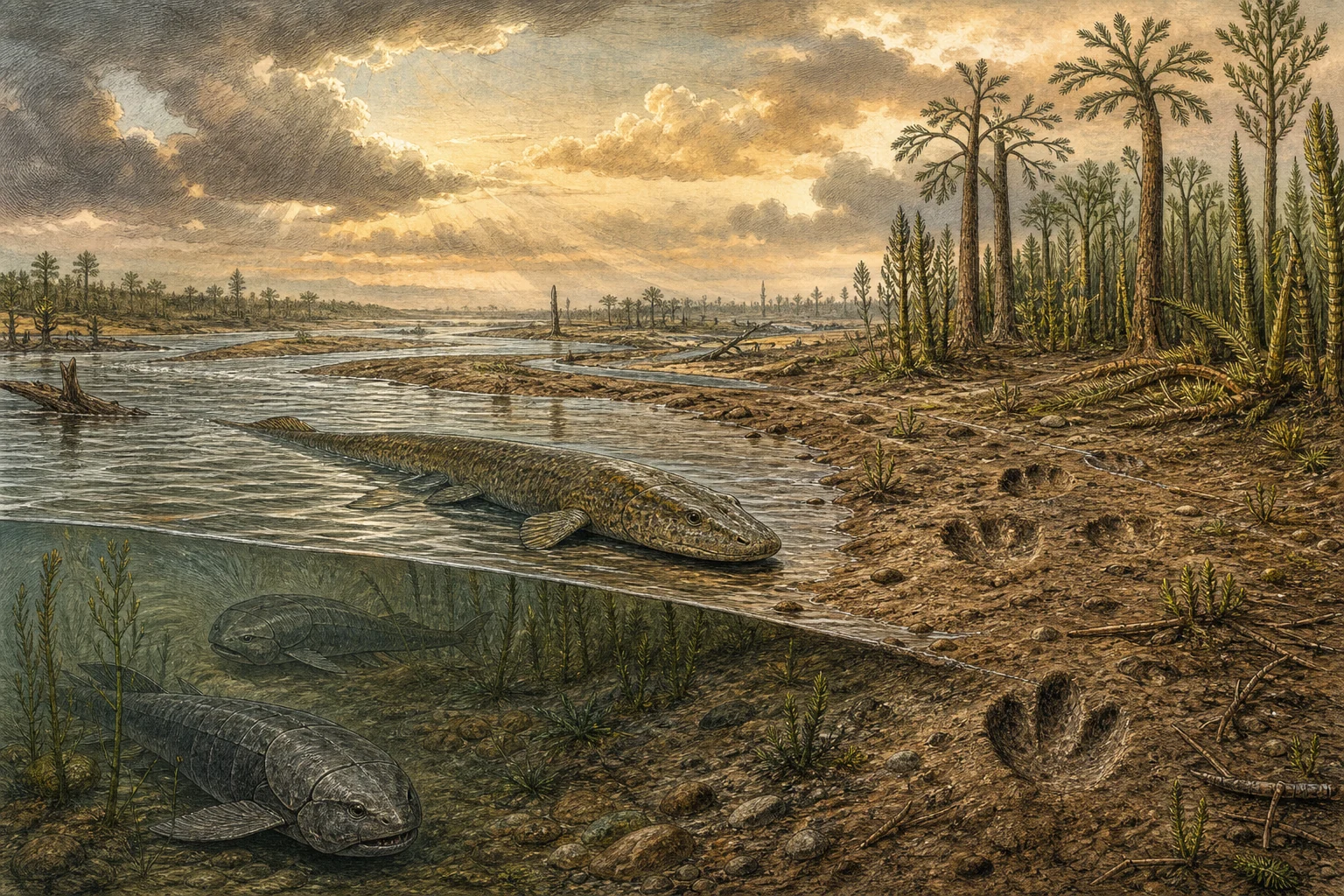
Tetrapods—amphibians, reptiles, birds, mammals, and their extinct relatives—belong inside the lobe-finned fishes. The movement onto land was therefore not a fish transforming suddenly into a terrestrial animal. It was a branching, mosaic transition in which features evolved in aquatic lineages and were later recruited in new settings.
An inherited limb pattern
Lobe-finned fishes possessed robust internal bones. In forms close to tetrapod ancestry, a single upper element connected to two lower elements, followed by smaller bones: the historical framework of humerus, radius, and ulna. Tiktaalik, about 375 million years old, combined scales, fins, and gills with a mobile neck, flattened skull, strong ribs, and a wrist-like joint capable of support.
Yet Tiktaalik was aquatic. Later Devonian tetrapods such as Acanthostega had digits while retaining tail fins and aquatic specializations. Digits did not wait for fully terrestrial walking; limbs may first have maneuvered through vegetation, shallow bottoms, or oxygen-poor water.
Breathing was already diverse
Air breathing also preceded land life. Lungs occur in several fish lineages, and swim bladders are evolutionarily related organs. In warm, stagnant waters, gulping air could supplement gills. Head mobility, stronger axial skeletons, sensory changes, and weight-bearing joints evolved at different rates.
Footprints older than some familiar body fossils remind us that discoveries can revise timing without dissolving the transition. Fossils are samples of once-widespread populations, not a complete chain of named ancestors.
Land required more than legs
Early tetrapods remained tied to water for reproduction and vulnerable skin. Later innovations—stronger vertebral columns, remodeled ears, more effective locomotion, water-resistant coverings, and ultimately the amniotic egg—expanded terrestrial life.
The shoreline was not a finish line. It was a shifting ecological border crossed repeatedly for feeding, refuge, dispersal, and reproduction. Every human hand retains the architecture of fins that evolved before any vertebrate footprint marked dry ground.