FOLIO · S · Sources & evidence
Follow the specimen label.
The archive favors primary historical material, museum collections, scientific institutions, and sources that reveal how a conclusion was reached.
A hierarchy of trust.
For Darwin’s own words and working process, we link to digitized publications, notebooks, manuscripts, and correspondence. For modern claims, we prioritize peer-reviewed synthesis, museum research programs, geological standards, and university collections.
Popular explanations may help orientation, but they do not replace the evidentiary trail behind a contested or precise claim.
What a citation should do.
- Identify the publication, collection, or institution clearly enough to find it again.
- Support the claim beside it—not merely the general subject.
- Prefer stable pages, persistent identifiers, and original editions when available.
- Separate historical testimony from modern scientific interpretation.
Images are reconstructions.
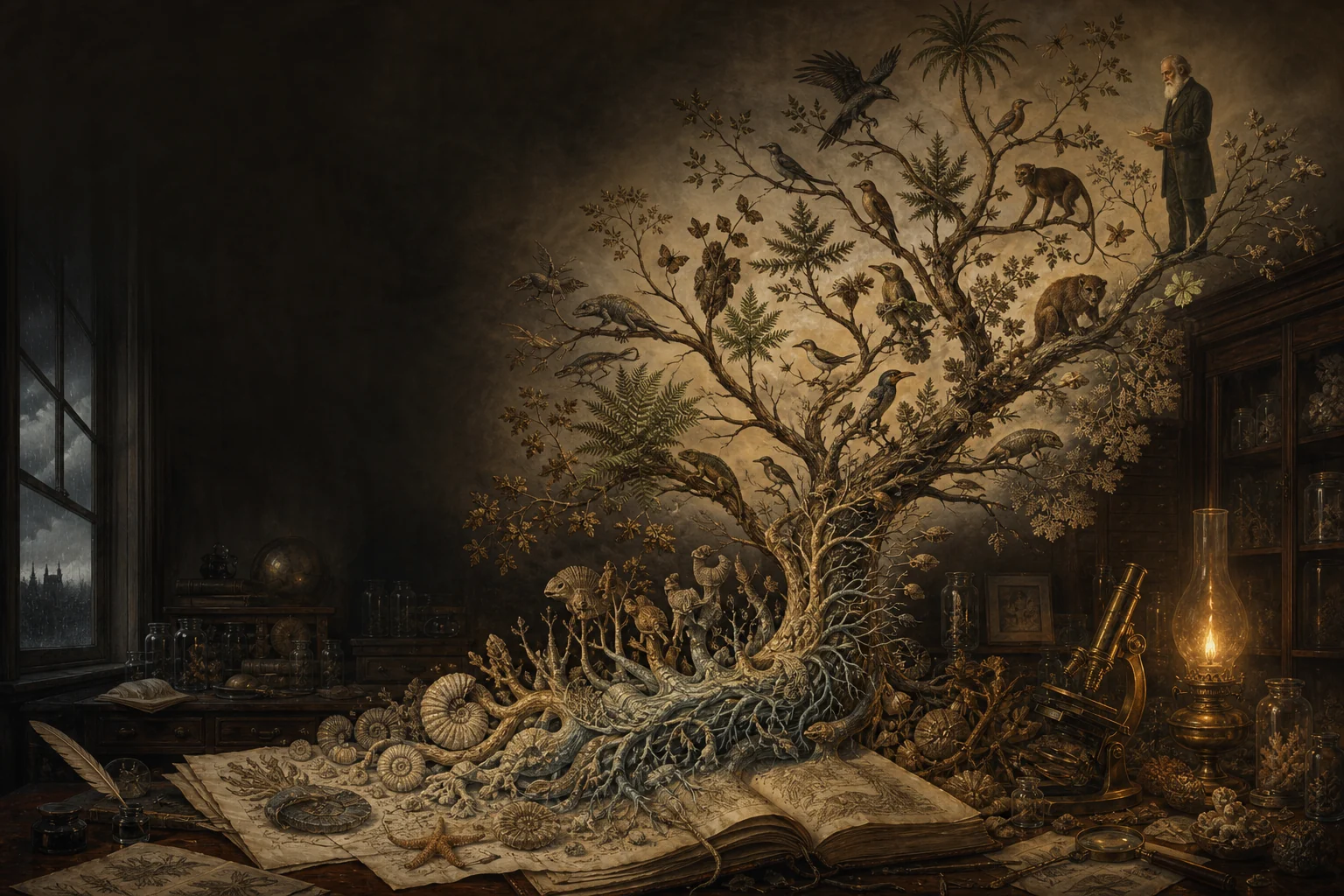
The site’s generated plates are atmospheric scientific illustrations, not photographs of extinct worlds. They contain no embedded labels, and their captions identify subject, period, and interpretive status outside the image.
Anatomical plausibility is part of the brief, but no reconstruction can recover color, behavior, soft tissue, or habitat detail with equal confidence.
Reference register
Complete publications, editions, and searchable historical texts.
↗Darwin Online · ManuscriptsNotebooks, drafts, papers, and digitized manuscript records.
↗Smithsonian · EvidenceFossils, genetics, behavior, and the evidence for human evolution.
↗Smithsonian · DatingHow relative and numerical dating methods establish age.
↗Natural History Museum · FossilsFossilization, trace evidence, and limits of the record.
↗