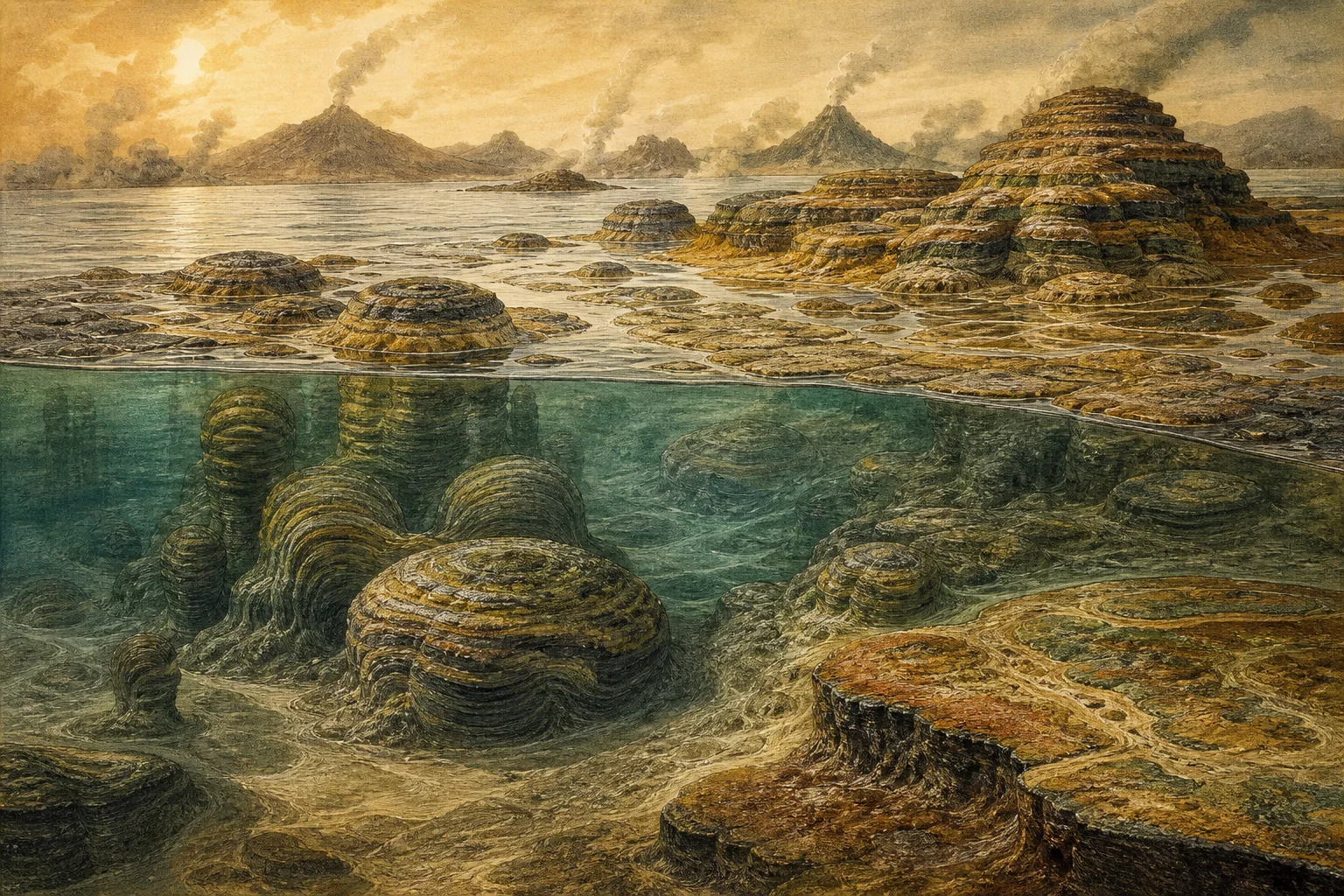
For much of Earth history, life was microbial and the atmosphere contained almost no free oxygen. Cyanobacteria changed that condition through oxygen-producing photosynthesis. Their innovation did not simply “improve” the planet: oxygen was chemically aggressive and toxic to many organisms. It caused ecological crisis while creating new opportunities.
A waste product changes the sky
Early oxygen reacted with dissolved iron and reduced minerals before accumulating in air. Geological evidence places the Great Oxidation Event around 2.4 billion years ago, although local oxygen oases existed earlier and oxygenation proceeded in pulses. Biology altered geology; geology in turn changed which metabolisms could prosper.
Oxygen supports highly efficient respiration, but it also damages molecules. Protective enzymes and repair systems evolved as lineages adapted or retreated into oxygen-free habitats. Anaerobic life did not disappear. It remains essential in sediments, soils, animal intestines, and global nutrient cycles.
Cells within cells
Eukaryotic cells contain a nucleus and complex internal architecture. Their mitochondria descend from bacteria that entered a lasting partnership inside another cell. Evidence includes mitochondria’s bacterial-style membranes, circular DNA, ribosomes, and division. This endosymbiosis turned former organisms into inherited cellular machinery.
Photosynthetic eukaryotes later acquired cyanobacteria as chloroplasts. Secondary endosymbioses occurred when one eukaryote engulfed another already bearing a plastid. Evolutionary trees are mainly branching, but these mergers show that the history of life also contains fusion.
Complexity is not a destination
More available energy helped support larger genomes, active predation, and multicellular bodies, but no law required complexity to increase. Bacteria and archaea remain extraordinarily diverse and biochemically inventive. Multicellularity evolved independently in animals, plants, fungi, algae, and other groups because adhesion, communication, and division of labor can be advantageous under certain conditions.
The Proterozoic was not a dull preface to animals. It was the long interval in which microbes transformed the atmosphere, cells became composite communities, and ecological relationships assembled the foundations of the visible biosphere.