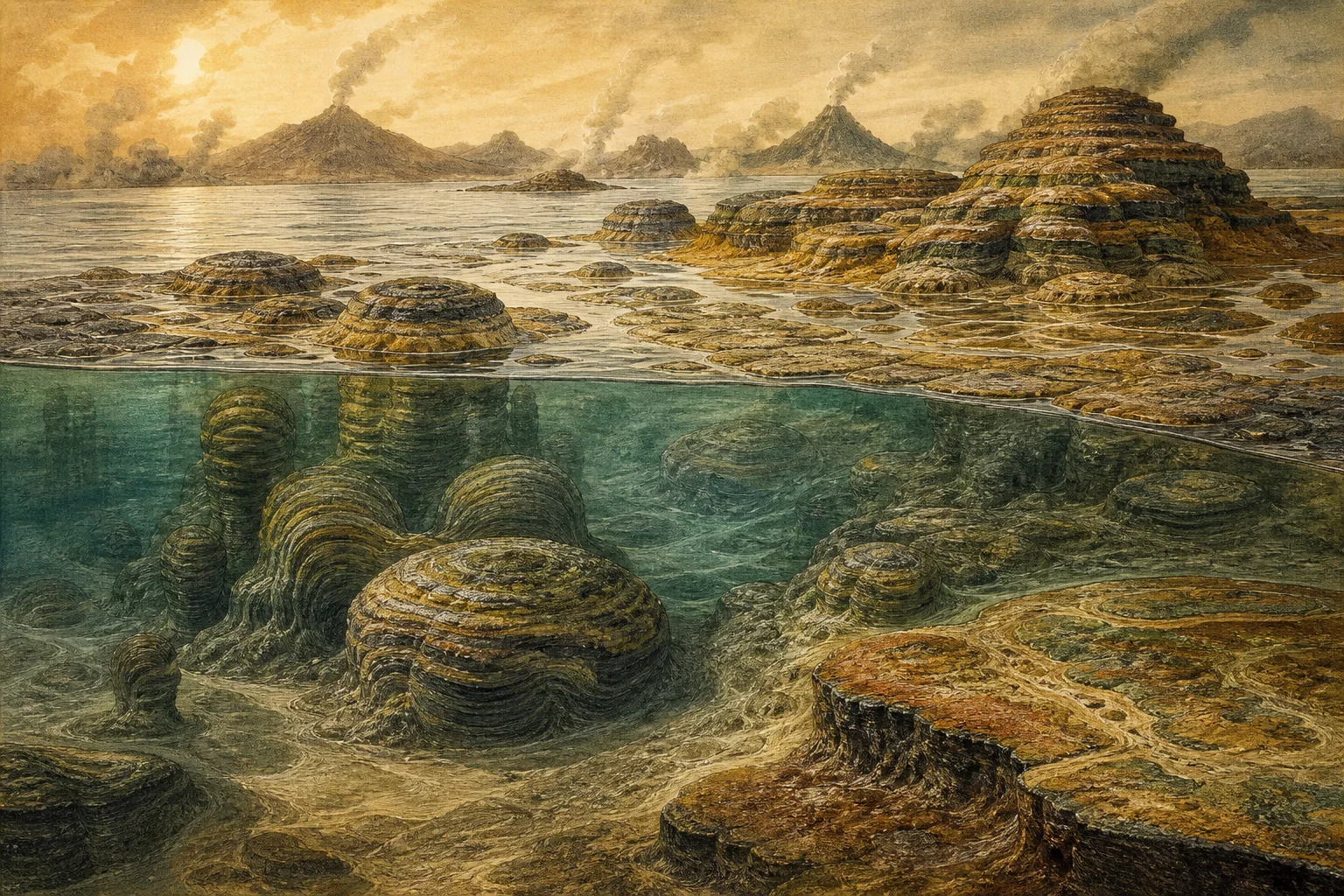
Evolution by natural selection explains how populations change once heredity and reproduction exist. The origin of life is a different research problem: how geochemistry produced systems capable of maintaining themselves, copying information, and evolving. No single scenario has yet crossed every step in the laboratory, and the earliest evidence has been altered by more than three billion years of geological activity.
A young planet becomes habitable
Earth formed about 4.54 billion years ago. As its surface cooled, liquid water, rock, atmosphere, and energy gradients created many chemical settings: volcanic pools, mineral surfaces, shorelines, ice, and hydrothermal systems. Researchers test several of these rather than assuming one universal cradle.
Carbon chemistry can build amino acids, lipid-like molecules, and nucleotide components under plausible conditions. Meteorites also delivered organic compounds. These ingredients are not life, but they show that prebiotic chemistry is neither unique to organisms nor chemically impossible.
Three problems, not one miracle
A living lineage needs at least a boundary, a metabolism, and heredity. Fatty molecules can spontaneously form vesicles. Networks of reactions can exploit environmental energy. RNA is especially important because some RNA molecules both carry sequence information and catalyze reactions. An “RNA world” is therefore a productive hypothesis, although researchers still debate how nucleotides accumulated, how replication became reliable, and whether metabolism preceded genetics.
Origin-of-life research does not seek a modern cell appearing at once. It investigates populations of imperfect chemical systems that could become more evolvable.
Evidence begins after origins
Possible chemical signatures and structures in Archean rocks are difficult to interpret because nonliving processes can imitate biology. By roughly 3.5 billion years ago, however, multiple lines of evidence indicate established microbial ecosystems. All organisms alive today share basic molecular machinery and genetic code, pointing to a last universal common ancestor. LUCA was not the first living thing; it was the population from which all surviving lineages descend.
Many earlier experiments in living chemistry may have vanished without descendants. The boundary between chemistry and biology was probably a history of populations, competition, cooperation, and selection—not a single illuminated instant.