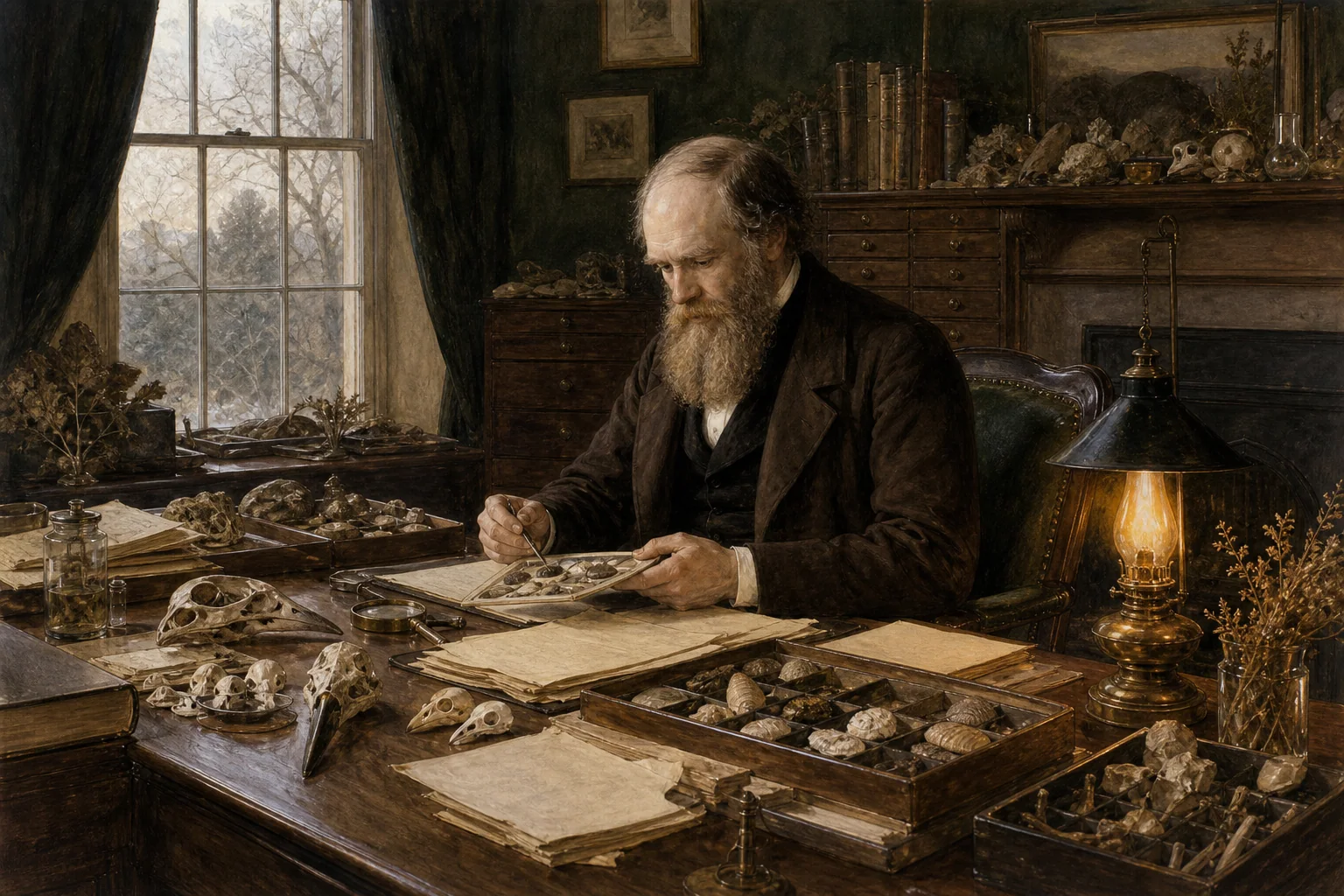
Charles Darwin boarded HMS Beagle in December 1831 as a twenty-two-year-old naturalist. He returned nearly five years later with notebooks, fossils, plants, animals, rocks, and questions. The voyage was foundational, but the familiar story of a sudden Galápagos revelation is misleading.
Geology taught him to see time
On Santiago in Cape Verde, Darwin saw shell-bearing strata raised above the sea. In Chile he experienced an earthquake and later found marine fossils high in the Andes. Charles Lyell’s geology offered a framework: immense changes could arise through processes still operating, given enough time.
Evolution would require precisely that scale. Deep time made gradual biological transformation imaginable.
Fossils joined extinction to geography
At Punta Alta in Argentina, Darwin excavated bones of enormous extinct mammals. These creatures were not identical to living armadillos and sloths, yet they resembled them. Why should extinct South American forms be allied to living South American forms rather than to ecologically similar animals elsewhere?
The pattern suggested succession with continuity: new inhabitants were somehow connected to former inhabitants of the same region.
Islands made variation spatial
In the Galápagos, Darwin noticed that mockingbirds differed among islands. Tortoise forms were said to reveal their island of origin. The finches became important later, after ornithologist John Gould recognized them as a closely related group of distinct species.
Darwin had not always labeled finches by island, and he did not formulate natural selection aboard the ship. The intellectual work continued in London, where specialists transformed collections into comparisons.
A specimen becomes evidence through context: where it was found, what it resembles, and how it differs.
Breeders provided a visible analogy
Artificial selection showed that accumulated choices could dramatically reshape pigeons, dogs, and crops. Nature made no conscious choice, but heritable variants also differed in survival and reproduction. Thomas Malthus’s writing on population sharpened the idea of competition under limited resources.
By 1838 Darwin had the core mechanism. He spent two decades testing it against barnacles, domestication, biogeography, fossils, and correspondence. When Alfred Russel Wallace independently developed a similar explanation, their ideas were presented jointly in 1858. On the Origin of Species followed in 1859.
The theory emerged not from one bird or one island, but from a network of connections: geological time, geographic replacement, inherited variation, extinction, competition, and the branching pattern of resemblance.