Deep time is difficult not because its numbers are complicated, but because human intuition evolved for seasons and lifetimes. Earth is about 4.54 billion years old. If its history were compressed into a single day, complex animals would appear after 9 p.m.; our species would arrive only in the final seconds.
Rocks are ordered pages
Sedimentary layers accumulate in sequence. Unless later forces overturn them, younger layers lie above older ones. Fossils characteristic of particular intervals allow geologists to correlate separated exposures. These relative methods were powerful long before anyone could calculate an age in years.
Radiometric dating added clocks. Unstable isotopes decay at predictable rates, so minerals can record when they crystallized. Different isotope systems suit different timescales and materials. Dates are tested against stratigraphy, paleomagnetism, volcanic layers, and other independent evidence.
A fossil is not merely an object in stone. Its position is part of the evidence.
The record favors some lives
Fossilization is rare. Hard parts preserve more readily than soft tissues. Rapid burial helps. Marine sediments are more extensive than mountain habitats. A gap in the record therefore does not imply that nothing lived; it tells us about preservation, exposure, and discovery.
Exceptional deposits—such as the Burgess Shale, Solnhofen limestones, and Ediacaran beds—briefly open windows onto soft bodies and entire communities. Most of the story must be reconstructed from more scattered evidence.
Transitions are branching populations
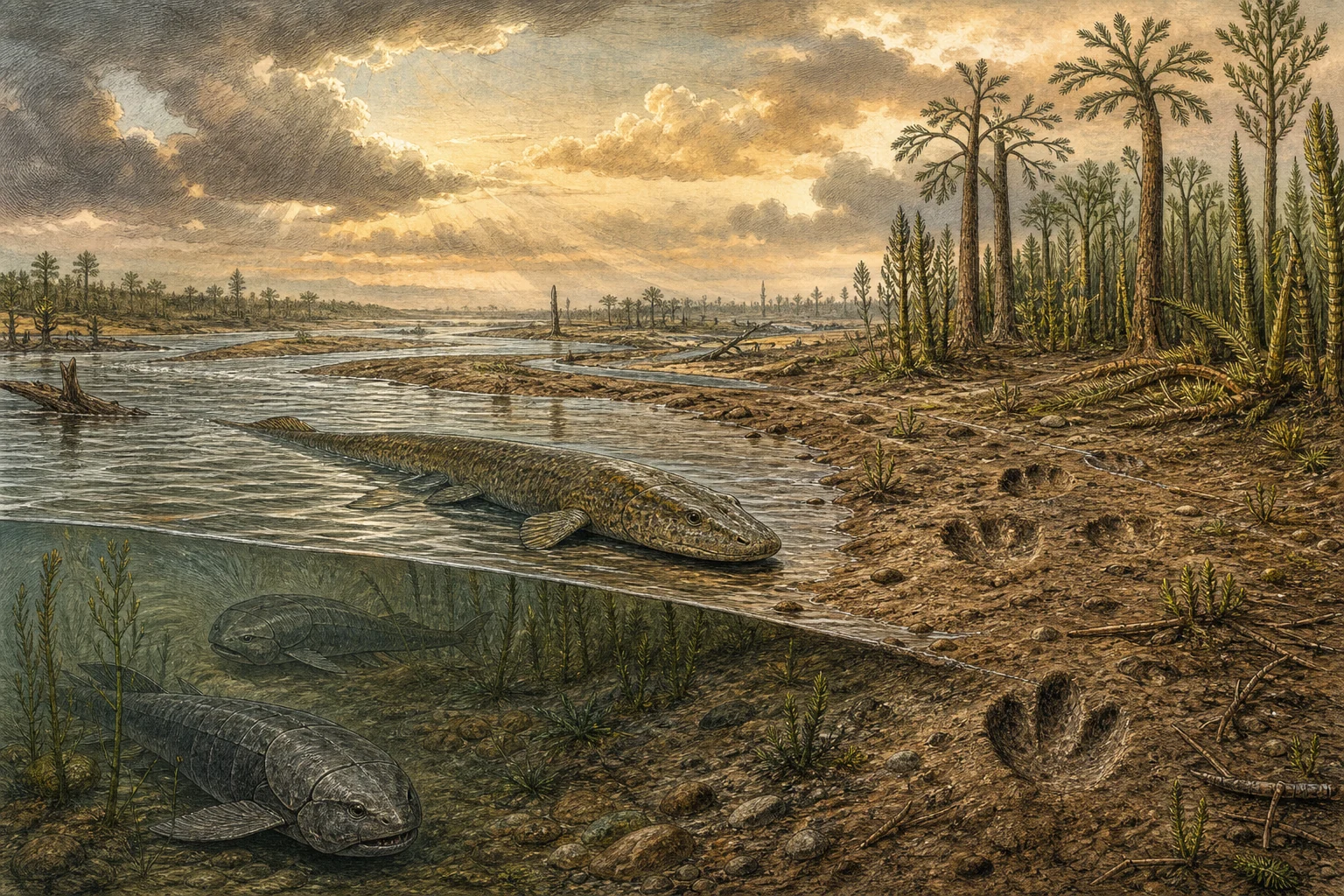
“Transitional fossil” does not mean a half-finished creature. Every organism is fully adapted enough to have lived. A transitional form combines ancestral and derived traits that help locate it on a branching tree. Tiktaalik, for example, had fishlike scales and fins alongside a mobile neck, robust ribs, and limb bones related to those of tetrapods.
Lineages branch. One fossil species need not be the literal ancestor of a later species to reveal the sequence of change; it may be a close cousin preserving a similar combination of traits.
Several clocks tell one history
Fossils, embryology, comparative anatomy, biogeography, and DNA are not separate stories. They converge. Genetic differences accumulate in patterned ways. Island species resemble nearby mainland relatives. Vertebrate limbs share underlying bones. Rocks place forms in temporal order.
Deep time becomes legible when independent clues agree—not as a perfect chronicle, but as a tested historical reconstruction whose details continue to sharpen.