Natural selection is a statistical consequence of three ordinary facts: individuals in a population vary, some of that variation is inherited, and not every individual contributes equally to the next generation. No creature needs to understand the process. No species must strive toward a predetermined form.
Populations, not individuals, evolve
An individual may grow, learn, acclimatize, or age, but its inherited variants do not become more common merely because it changes. Evolution is measured across generations, as the composition of a population shifts. A pale moth does not turn dark because a tree trunk darkens; if darker moths leave more surviving offspring in that environment, dark variants may become more frequent.
Variation comes first. Mutation changes DNA. Recombination produces new combinations. Development and environment influence how genetic differences are expressed. Selection then filters outcomes in a particular place and time.
Natural selection is not “survival of the strongest.” It is differential reproductive success under specific conditions.
Adaptation has a history
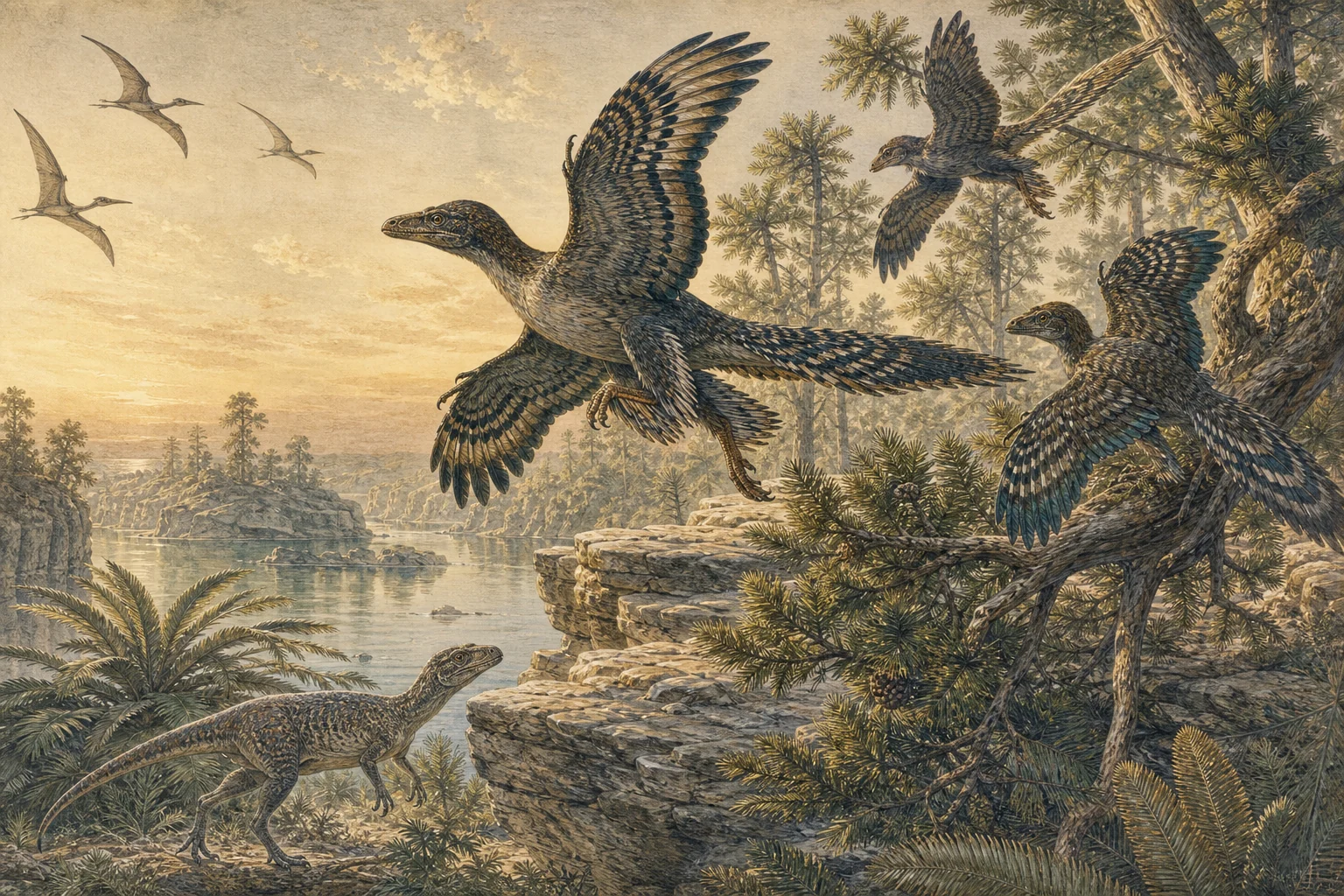
A wing is not designed from nothing for flight. Feathers likely served insulation, display, brooding, and balance before being recruited into aerial locomotion. Structures can acquire new functions—a process called exaptation—because evolution modifies inherited materials rather than beginning with a blank page.
This history explains biological imperfections. The recurrent laryngeal nerve takes a remarkable detour in giraffes because it inherited a route established in distant fishlike ancestors. Human backs, knees, and difficult childbirth reflect compromises, not optimal engineering.
Selection is one mechanism among several
Genetic drift changes variant frequencies by chance, especially in small populations. Gene flow moves variants between populations. Mutation creates new variants. Sexual selection favors traits through mate competition and choice. Natural selection is powerful, but it does not act alone.
Nor does selection always produce complexity. Parasites may lose structures their ancestors needed. Cave animals may lose eyes. What persists is not what is “higher,” but what reproduces under prevailing conditions.
Fitness belongs to a relationship
Biological fitness is not a permanent rank. A thick coat may be advantageous in cold conditions and costly in heat. Antibiotic resistance can help bacteria in the presence of a drug while imposing costs in its absence. Change the environment and the selective landscape changes with it.
The result is a living world that looks designed because countless generations preserved workable relationships between organisms and environments. Darwin’s insight was to explain that appearance through a natural process—patient, branching, and without foresight.