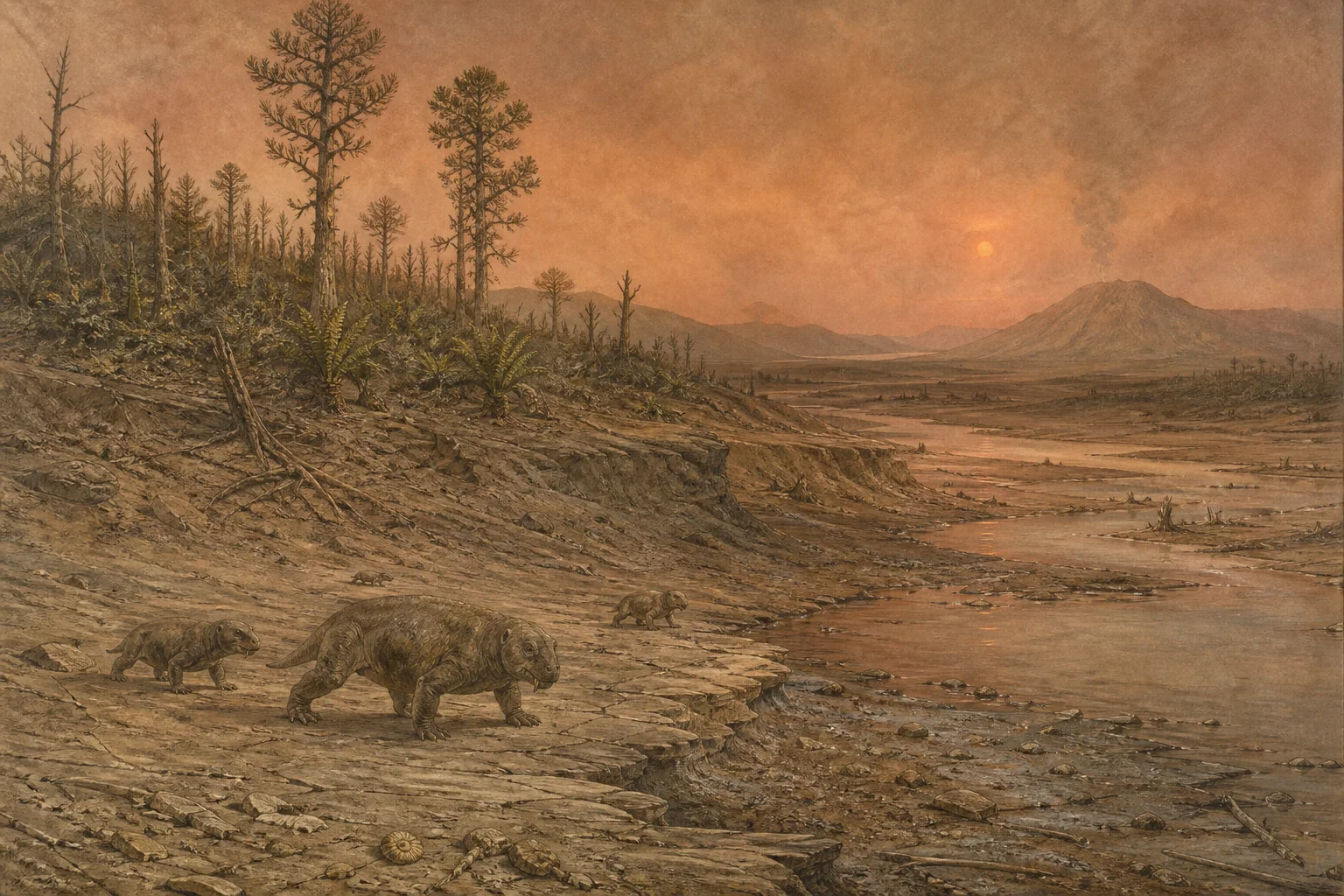
Extinction is the ordinary termination of lineages; most species that have existed are gone. A mass extinction is different in scale and tempo: losses become global, rapid in geological terms, and spread across many ecological groups. Paleontologists commonly recognize five major crises in the last 541 million years.
The five crises
The end-Ordovician event, about 444 million years ago, coincided with glaciation, sea-level fall, and later warming. The Late Devonian crisis unfolded in pulses and disproportionately affected reefs and marine communities. The end-Permian extinction, about 252 million years ago, was the most severe; Siberian volcanism drove warming, ocean acidification, oxygen loss, and cascading disruption.
At the end of the Triassic, enormous volcanism accompanied the breakup of Pangaea and cleared ecological space in which dinosaurs later dominated. At the end of the Cretaceous, 66 million years ago, an asteroid struck Chicxulub. Ejected dust and aerosols darkened and cooled the planet, collapsing food webs already living amid environmental change.
Extinction is selective
Disaster does not draw species at random. Geographic range, body size, diet, habitat, reproductive rate, and physiology affect vulnerability. Yet a trait helpful in one crisis may fail in another. Survival is not proof of superiority; it is compatibility with a particular disturbance and a measure of contingency.
Recovery also takes time. “Disaster taxa” may spread first. Ecosystems reassemble over millions of years as surviving lineages diversify and new interactions emerge. The replacements are not replicas of what was lost.
The present acceleration
Today habitat destruction, exploitation, introduced species, pollution, and human-driven climate change are raising extinction rates. Whether the result is labeled a sixth mass extinction depends on definitions and future losses, but the direction of risk is not ambiguous.
The geological record offers no promise that diversity rebounds on human timescales. Evolution eventually generates novelty, but extinction permanently erases singular histories. A recovered biosphere is another biosphere.