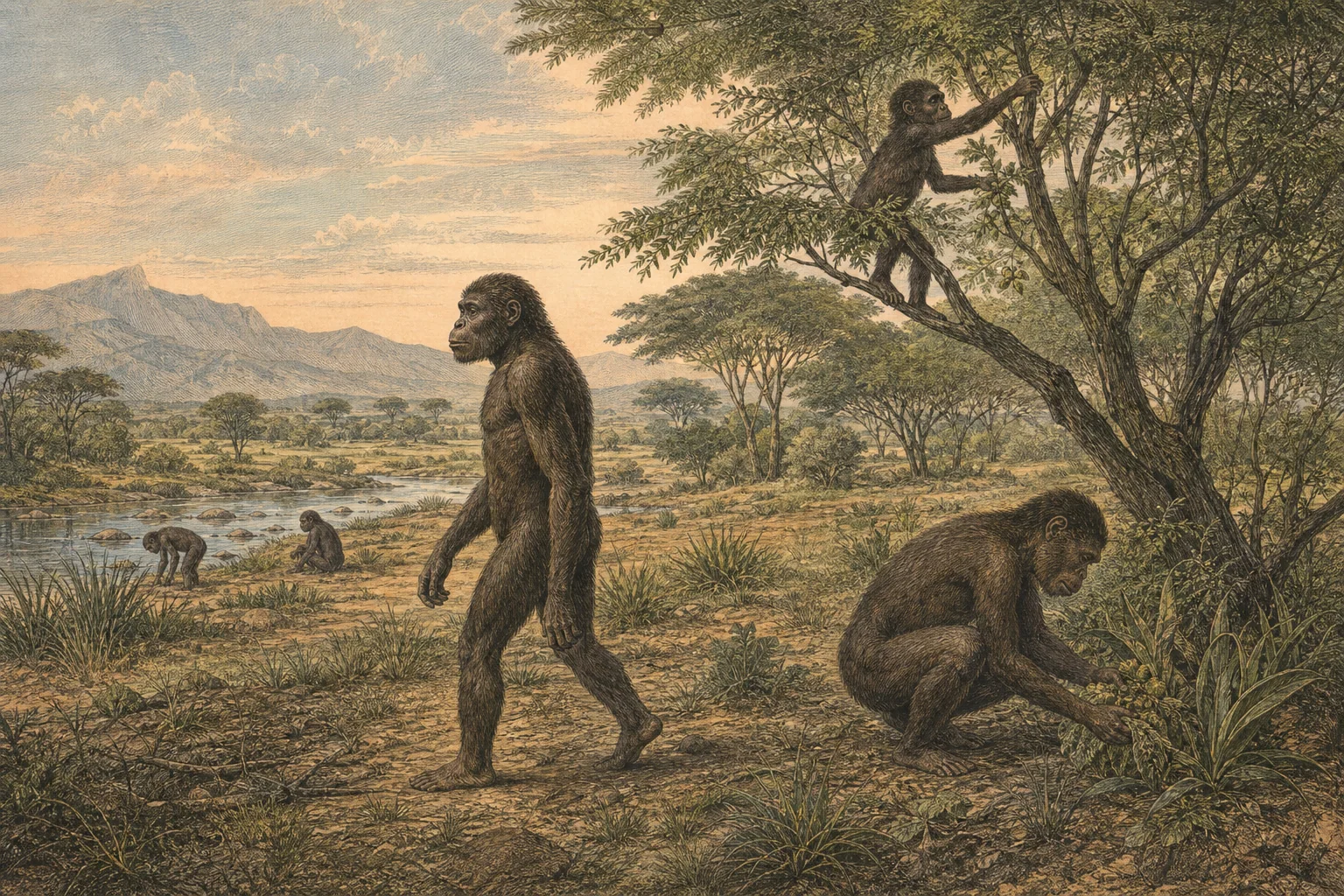
Humans did not evolve from chimpanzees. Humans and chimpanzees are living branches that share an extinct common ancestor. Our lineage belongs within apes, primates, mammals, tetrapods, vertebrates, and animals. Human evolution is therefore not an ascent away from nature, but one local history inside it.
Bipedal before big-brained
The earliest probable hominins lived in Africa roughly six to seven million years ago. Fossils preserve mosaics: skull and teeth may indicate one pattern while hips, legs, hands, or climbing anatomy indicate another. Habitual bipedality developed long before large brains. Australopithecus species walked upright yet retained adaptations useful in trees.
There was no single-file march. Several hominin species coexisted. Some robust australopiths specialized in heavy chewing and left no living descendants. Early members of Homo overlapped in time and varied in anatomy, technology, and range. Fossil species are hypotheses about populations, not perfectly bounded boxes.
A genus disperses
Homo erectus and related populations expanded beyond Africa by about 1.8 million years ago. Longer legs, flexible diets, tools, social learning, and eventually habitual fire use formed changing packages rather than one sudden threshold. Brain expansion carried energetic costs and unfolded alongside childhood, cooperation, food processing, and environmental variability.
Our species, Homo sapiens, evolved in Africa at least 300,000 years ago. Fossils from different regions support a continent-wide, structured origin rather than a single tiny birthplace. Later dispersals carried populations across the world.
Separation with reunion
Ancient DNA transformed the family tree. Modern humans interbred with Neanderthals and Denisovans; many people today retain ancestry from those encounters. Gene exchange did not make the groups identical, but it means replacement was not absolute.
Culture also changes evolutionary conditions. Tools, cooking, language, medicine, cities, and agriculture alter environments and selection. Cultural inheritance can move much faster than genes, while genes and culture sometimes coevolve—as with adult milk digestion in some pastoral populations.
Only one hominin species survives, but one is not the natural culmination of many. It is the present remnant of a once-bushy family, carrying genes, anatomy, and behaviors assembled across intersecting histories.