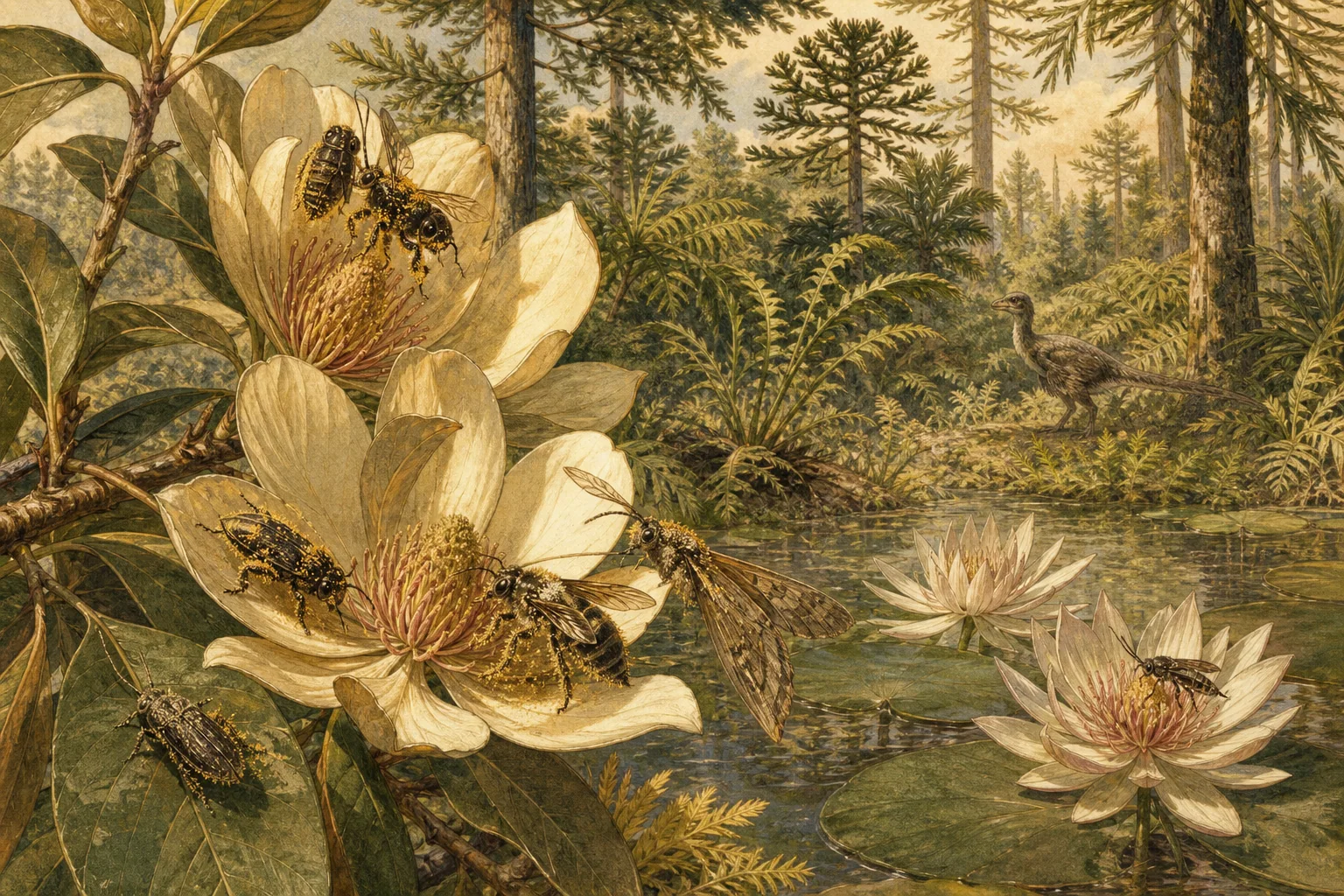
An organism’s environment includes climate and soil, but also predators, prey, parasites, competitors, partners, and hosts. When interacting lineages impose reciprocal selection on one another, they may coevolve. The result can be close cooperation, escalating conflict, or both at different times.
Flowers and their visitors
Darwin treated orchids as evidence that elaborate fit could arise through accumulated selection. Flowers vary; pollinators differ in which variants they visit and successfully transfer pollen from. Plants in turn influence which feeding structures or behaviors benefit pollinators. Long floral tubes and long proboscises can become mutually reinforcing without either species planning the match.
Yet not every partnership is a pair. A flower may be visited by many insects, and an insect by many plants. Diffuse coevolution acts through networks. Relationships can also shift when species enter new places or when a partner disappears.
Arms races and uneasy truces
Hosts evolve defenses; parasites evolve ways around them. Prey improve concealment or toxins; predators improve detection or resistance. Because each adaptation changes the selective environment of the other lineage, advantage can be temporary. The Red Queen metaphor describes populations evolving continually just to maintain their relative position.
Cooperation is equally evolutionary. Mycorrhizal fungi trade soil nutrients for plant carbon. Animals host microbial communities that help digest food. Such partnerships persist when mechanisms align interests, but conflict never vanishes: partners can cheat, police, replace, or exploit one another.
Evidence requires reciprocity
Matching traits alone do not prove coevolution. Similarities may reflect the same climate, one-sided adaptation, or common ancestry. Researchers test reciprocal effects with phylogenies, geographic comparisons, experiments, and measurements of selection.
Coevolution explains why species cannot be understood as isolated designs. Every lineage inherits a world already altered by others. Natural selection is local, but its consequences travel through food webs, mutualisms, diseases, and ecosystems—making the tree of life an evolving web of relationships.